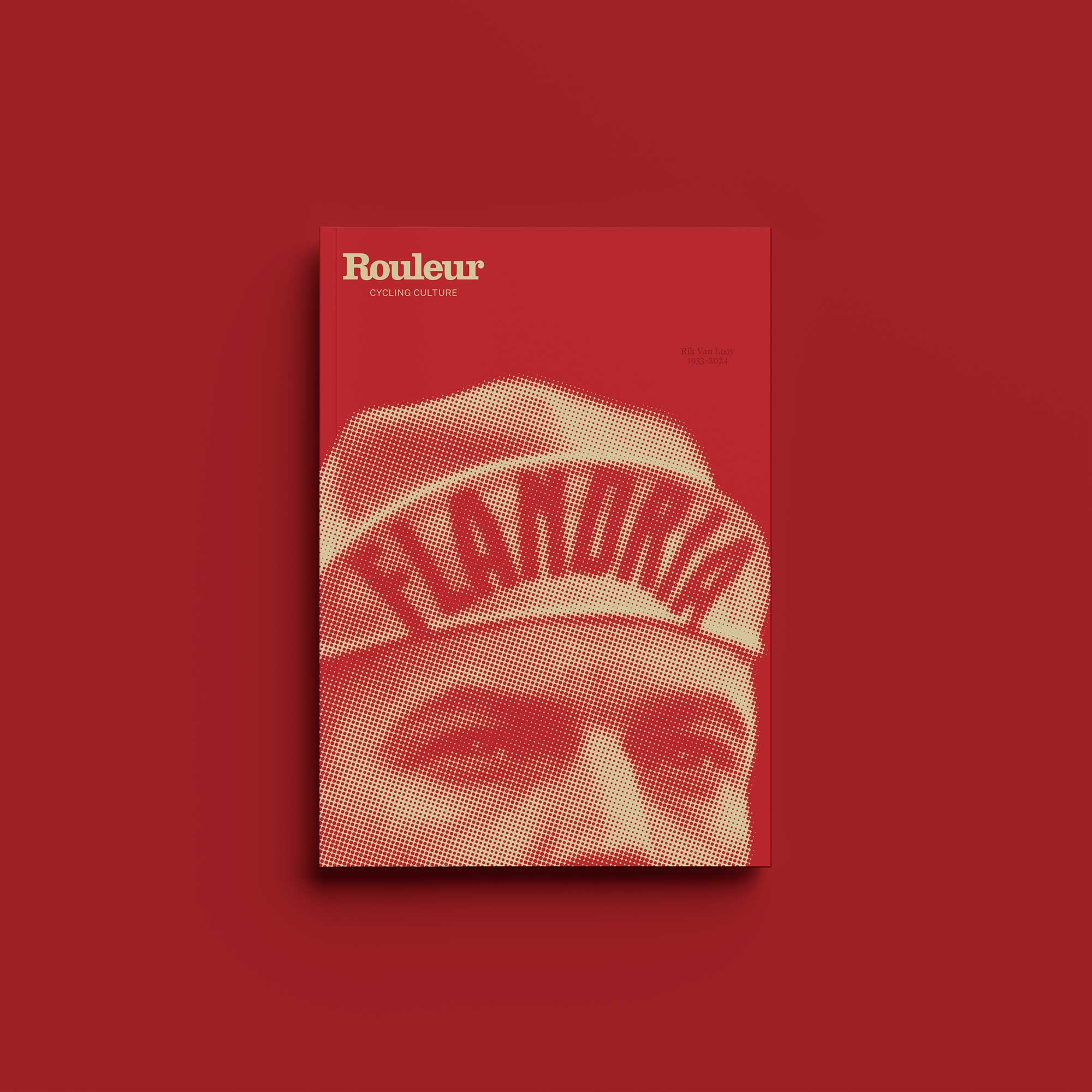
This article was first published in Rouleur Issue 143
An amazing clip surfaced in 2023 of the legendary Irish rugby player, now coach, Ronan O’Gara giving a dressing room speech to his La Rochelle side. It’s an expletive-laden hairdryer treatment delivered in French, interspersed with English swearing, all in a strong Cork accent. My favourite line? “L’opportunité est f ***ing énorme”. It resembles the kind of stirring oration used to motivate the masses before battle, now commonplace in professional sport. Inspiring, if not a bit intimidating.
Eddie Dunbar isn’t a bloke who needs much convincing to turn himself inside out. For over a decade, he has been stomping away on the pedals, always pushing, never relenting, often grimacing, and rarely making it look easy.
The Irishman from Banteer has more than a hint of O’Gara about him, albeit in the moments when the rugbyman is more subdued and spouting fewer F-bombs. Yes, they both sport similar trims and have those steel blue eyes, but the similarities extend beyond appearance. The two Cork-men possess a blend of raw competitiveness and affable personal presence, which come across easily and frequently. And there is more. It was the oval ball of O’Gara, who played for Munster – the provincial side of Dunbar’s native County Cork – not cycling’s two wheels that first captured the young Dunbar’s attention, and still does.
“I was playing rugby at 12. I loved it, and I still love it now – I prefer watching rugby to cycling,” said Dunbar, now 29.
The Irish rugby team is going through a slight transition after a golden period which saw them top the world rankings in 2023. Speaking to Rouleur on the day of the Six Nations opener, Dunbar was pragmatic about his side’s current situation, especially against the star-studded French.
“We need a bit of a refresh, and it looks like our hand has been forced into doing that.” A refresh. Dunbar knows a thing or two about that. Over the winter, he moved from WorldTeam Jayco-AlUla to ProTeam Pinarello Q36.5. Before his time at Jayco, where he won two memorable Vuelta a España stages in 2024, Dunbar was in the ranks of Team Sky, now Ineos Grenadiers. Despite glimpses of his ability, Dunbar didn’t manage to fulfil his potential at the British squad brimming with talent in the late 2010s and early 2020s.
Jostling for position, results and leadership is something the plucky Dunbar has had to do ever since he got on a bike.
“When I first started, I wasn't the biggest guy. I'm still not the biggest guy, but I was really small, and I wasn't winning compared to other guys my age. That can be pretty demoralising at that age too, when you're not really doing well.
“I was always just told to keep at it. It's a game of catch up, and if you stick with it, it pays off. I'm happy I did, because I remember there were times I was thinking, I don't really enjoy this, I'm not getting anything out of it. “I think it probably shaped me in terms of the methods I use in training, as it is based on hard work and keeping going.”
Hard work. Keeping going. It’s the stuff O’Gara instills in his La Rochelle players. In an era when scouts scour the junior ranks, race results and even other sports for natural talent, it’s easy to forget what underpins success in all sports: consistent hard work. The gifted v graft trope is relevant in every sporting endeavour. Obviously professional riders possess both, but not all junior riders do, and there is a lot to be said for missing out on initial success. Learning how to work hard is a talent, one which Dunbar honed in his early years in the sport. That initial height hindrance became a ladder on which he climbed the ranks of Irish cycling.
It was at Kanturk Cycling Club, under the tutelage of Dan Curtin, where Dunbar’s talent began to shine through.
“Dan was known for, as we say, ‘putting legs on guys’. And thankfully, he put a good pair of legs on me as well,” Dunbar said with a fond smile. “Growing up, I was lucky enough there was one of the best underage clubs in Ireland, in Kanturk, and it was basically five kilometres from my house.
“If you go back through the years, it was known for producing good riders and I think Danny Curtin has a lot of credit to take for that. Danny was always very confident that if you did what he said and did it well, you were going to make it. That's kind of what I did. Anything I did from a young age was guided by Danny – wherever I went, whichever team I went to, I was always guided by him.” Curtin had experience of turning promising juniors into professionals. Among his former tutees is the 2020 Tour de France green jersey winner, Sam Bennett – now a teammate of Dunbar’s at Pinarello Q36.5. Six years Bennett’s junior, Dunbar had a path to follow, even if his size and style didn’t correlate to that of the older man. Success soon followed the hard work.

“I started to win a few races, and when I got to the under 16 category, I won a lot more. And then the same in the junior category,” said Dunbar. “And I wasn't just winning in Ireland, I was able to win abroad and on a world level and that's when I thought, I could probably make a career out of this.” The persistence landed him in the Continental ranks, first with NFTO and then Axeon Hagens Berman. In 2017, Dunbar won the U23 Ronde van Vlaanderen ahead of Jasper Philipsen. Then came a Pro-continental contract at Irish team Aqua Blue Sport, who he rode with for nine months before achieving what he had always grind-ed for: a WorldTeam contract with then the best squad in the world, Team Sky, in September 2018.
However, this brought a new challenge. It may not be as burdensome as being France’s next general classification hope, but Ireland has a rich cycling history, and there is a pressure associated with being its top rider. The Emerald Isle has been looking for its next prodigy since the exploits of two men in the 80s. Munsterman Sean Kelly is regarded as one of the greatest Classics riders ever, with nine Monuments and four green jerseys at the Tour de France. Stephen Roche achieved the rare ‘Triple Crown’ (Giro d’Italia, Tour and World Championships) in 1987. The Dubliner was the last to do so before 2024, when Tadej Pogačar waltzed to all three wins – and the rest... Dunbar was once touted to be his country’s first Grand Tour winner since Kelly’s 1988 triumph at the Vuelta a España. But cycling has changed considerably in the last 40 years. Dunbar might well have been better suited to the Grand Tours of the past, where a general classification rider could build their way to a final week crescendo.
“I prefer when it’s harder going into the climbs. It suits me much better when the other riders are a bit fatigued. What I can do for ten minutes, I could probably do two or three times, as opposed to once off. I know this is the kind of rider I am. It takes me a while to get into a race, and the harder a race is before a climb, the better for me,” Dunbar told Rouleur.
However, we are in the Pogačar era of Grand Tours. There is no room for slow burners. If there is a kicker on stage two, Pogi will attack; if there are crosswinds on stage three, Visma-Lease a Bike will launch; if there is an early Grand Tour time-trial, Remco Evenepoel will gain heaps of time. No chance to ease in.
Dunbar seems caught in between two eras of professional cycling – too young to compete in the last of the ‘traditional’ style Grand Tours, yet too old to be among the current crop of whipper snappers, who grew up with personalised nutrition, lactate tests and were living like professionals while still at school. Riders can’t rely on pure grit like in the days of Kelly and Roche. Tinkering with training techniques, whether you like it or not, is here to stay.
“You have to start doing it or you’ll get left behind pretty quick. You're just going to suffer in a race if you don't do it,” said Dunbar. “It’s only been in the last two or three years where I've really dialled in on nutrition and the small bits, like with the tyres and position on the bike. I spend a lot of time in the altitude tent now as well.
“Every race is important. Before Covid, you could go to a race and use it as preparation. You were like alright, I’ll go to this race so I'm good for that race. Whereas now you have to be at a good level to go to any race. Every rider is doing everything they possibly can to be as good as they can, while maybe a few years ago, that wasn't the case. A lot of guys wouldn't have done altitude camps, but now they do them to not get dropped in races. The level is incredible. The speed has gone up and it’s mad how much the level goes up year on year,” explained Dunbar.
Nowadays any weakness will be exploited. Pogačar, and the lack of chinks in his armour, has changed the sport forever. Not only for the marvels he achieves on the bike, but also the way teams have to adapt their tactics and hiring around him.
Super teams are stacked full of talent, which for all their successes can sometimes stifle emerging prospects. This is something Dunbar was a victim of at Team Sky. When he signed for the British outfit in 2018, the squad had won six of the previous seven Tours. In Chris Froome, Geraint Thomas and Egan Bernal, they had the best Grand Tour stars of the peloton. And with plenty more options on the roster, they weren’t struggling for riders to step up elsewhere. Dunbar never got a sniff of a Tour start during his time in the squad. But, that didn’t mean there weren’t flashes of his ability – third on stage 12 of the 2019 Giro d’Italia, fourth at Giro dell'Emilia 2020, and the overall win at Coppi e Bartali 2022. It was enough to persuade Jayco-AlUla to sign the Irishman for the 2023 season, a move that gave Dunbar a different perspective from what he had experienced before.
“There isn’t one way to run a cycling team. It's all very individual. Cycling is a team sport, that's for sure. Nowadays you need a team atmosphere, but it's so individual. One training plan isn't going to work for another guy. If this guy eats this amount of carbs, that doesn't mean it’s good for another guy to eat that amount of carbs. So it’s become more personalised for each rider. I think Ineos is a perfect example of where you were put in a system and it either worked for you or it didn't,” said Dunbar, adding: “It was an absolutely great team. I remember joining and thinking, you can see why this is the best team in the world. It was very clear to see – all the tools were there to become the best you could. But if it's not the right environment, or if it's not pitched to you in the right way, then it's not going to work. And I guess that's the beauty of sport as well. I think going to Jayco, I was just in an environment that allowed me to be myself a bit more. I had a lot more control over what I did and when I did it, and I started to see a better version of myself, and that was the main difference between the two teams.” In his first season at Jayco, in what was a gruelling Giro, he placed seventh – a career best performance over a three-week race. He wasn’t far off cracking the top five, only for a disappointing time-trial on stage 20 up to Monte Lussari, won by Primož Roglič ahead of Geraint Thomas. The following year he claimed those two stages at the Vuelta.
Dunbar enjoyed his three seasons with the Australian team, but if he has learnt anything in his decade as a professional, it’s how to be adaptable and know when to make the move – be it in a race or in his career. He left Jayco for Pinarello over the offseason, and as with his move away from Ineos, there were no hard feelings.
“I needed a change. Matt White leaving the team was a big push for me as well. One of the main reasons I went to Jayco in the first place was because of him, the way he works and just the atmosphere he created in the team. Once he left, I noticed a bit of a change and I think a lot of other riders might have as well. It's a great team. They have incredible staff, the riders were great. I just got to the point where I thought, right, I need a change here.” The lure of the project that Doug Ryder was building at Pinarello-Q36.5 was strong for Dunbar, who has prioritised the right team structure since his days at Ineos.
“I saw the team racing very well last year. They got some good results. And as the year went on, they were just getting better and better. You could see there was a bit of an atmosphere building. There was an aura around the team as well, which was massive.” A new team with a fresh approach shakes things up in any sport, especially one that is rapidly changing, like cycling. More mainstream sports like football have already gone through transitions of globalisation, talent spotting and nurturing and increased professionalism. So, in cycling’s new landscape, is there still room for a Dunbar-style rider in its top tier? For sure. Simon Yates’ patience and magnificent Colle delle Finestre at last year’s Giro is a prime example. All it would take is for a Grand Tour with a back-loaded route, plenty of time-trial kilometres and multiple summit finishes, and Dunbar could flourish. Yes, like the 2026 Giro d’Italia – his principal target of the year.

“These three week races are what I perform well in, and I enjoy. I get better as the race goes on, which is always nice. I’ll go to the Giro to be competitive. After the first week, that might be in terms of general classification, or it might be a case of going for a stage win. I think it's so important nowadays to go in with an open mind into a Grand Tour.”
He won’t be lacking in motivation, or recent Grand Tour success at his new team. Dunbar was inspired by Pinarello-Q36.5’s performance at last year’s Vuelta, where Tom Pidcock finished on the podium.
“You could see in the way they rode that Vuelta, they were like a team that had been around for 15 years. What I saw from the outside was the riders that were around Tom, all worked incredibly well for the three weeks – not just the first week or just the second day – they rode well for the three weeks.
“They bought into the fact that they have a leader who could be competitive, and they supported him 100 per cent, and their reward was a podium in a Grand Tour, which is massive for them. It was massive for Tom. You could see how much that meant for him, and that brings the level up of the team.
“Now with that probably comes a bit of expectation this year as well to build on it. But as I said, that should excite everyone. That's the challenge. But the main thing is this year we enjoy that challenge. Of course, there's pressure to perform, but let’s just enjoy the challenge of trying to become better in the team and building on a third place in the Vuelta. I think there's something good building within the team. And hopefully everyone's going to see the jersey at the front of some more big races this year.” There was a passion in the way Dunbar enthused about the team’s outlook. It was rousing. In Pinarello he has found the kind of squad environment, where teammates rally around and work hard for one another. It’s one that Dunbar thrives in and craves most of all. He is unlikely to put it like this, but for him and all those at Pinarello-Q36.5, “L’opportunité est f ***ing énorme”.